
What Are Readers Saying?
Hello, Selman. Sorry it’s taken me a little while to get back to you. To be honest, I have a lot of resources on this subject. But the method in your book is different—the first of its kind among the things I’ve read, at least—and I can confidently say it works. For one thing, I used to believe that growth meant leaving your comfort zone and putting yourself in all kinds of situations. Now I understand very clearly that, for the sake of your mental health, you need to leave environments that are bad for you. I also came to understand how to manage the relationship dynamics within my family. Of course, this may not be a complete account, because I haven’t finished the whole book yet. Still, thank you for writing it. Methods like these are worth their weight in gold to people like us who can’t find a way out and feel worn down every single day because of it. Thank you 🙏🏻
I’ve had a chance to take a quick look through it. Your color analogy supports what I’ve read so far about the concepts those colors represent. I think it’s a successful piece of work. I’ll share my thoughts again once I’ve finished it.
Here are my thoughts so far: I realized that we’ve come to treat the effects of situations we recognize in our relationships as normal. Sometimes we’ve managed to take action, whether the outcome was positive or negative; other times, we haven’t even tried and have simply accepted things. But we don’t have to.
This book helped me understand that we don’t need to make a drastic decision like cutting someone out of our lives. Instead, knowing how to respond gives us real awareness and an advantage. This is a valuable piece of work, with detailed analysis and a great deal of effort behind it. Personally, I’ve found it very helpful as a guide. Thank you for all your work. Thank you…
But I need to show you why I wrote this book for you, and why what’s inside really works.
So let’s start at the beginning.
Tell me something.
Has This Ever Happened to You?
Someone takes a dig at you. Makes a cutting remark. Belittles you.
And you freeze.
You want to say something, but nothing comes to mind. You just stand there. Maybe you force a smile. Maybe you nod and brush it off.
It looks like the moment has passed.
But it hasn’t.
Because the real problem isn’t that moment. It’s what happens afterward.
You come home that evening. You eat dinner, lie down in bed. And the moment comes back.
“I wish I’d said this.” “I could have answered like that.” “Why couldn’t I say anything?”
Those words, that face, that moment keep circling in your head all night. You wake up the next morning, and they’re still there.
Most people explain this to themselves the wrong way. “I must not be smart enough.” “I’m just not quick-witted.” “They’re smarter than me—that’s why I froze.”
None of that is true.
Freezing Has Nothing to Do with Your Intelligence.
Look at what’s really happening.
When someone attacks you, your brain reads it as a threat. And in the face of a threat, your brain focuses on one thing: protecting you.
It briefly switches off the part that thinks, produces words, and gives you that sharp mind—your prefrontal cortex.
So at the very moment you need to say something, it shuts down the part that comes up with what to say.
You don’t freeze because you’re stupid. You freeze because, in trying to protect you, your brain shuts down the part that lets you speak.
This happens to everyone. Even the most intelligent people.
So Why Does It Keep Haunting You Afterward?
This is the most crucial part.
You didn’t do anything in that moment. You froze. The encounter was left unfinished.
And your brain can’t stand unfinished business. It keeps bringing an unresolved experience back to you until it’s resolved.
That’s why the moment returns at night.
Your brain isn’t trying to torment you. It’s trying to finish what was left unfinished. Because you didn’t finish it then.
And here’s the real trap: you’ve always tried to solve this by pushing the thought away, doing breathing exercises, or telling yourself, “Let it go. Don’t dwell on it.” None of it stuck.
Because what you experience at night is only an echo. The real event happened that afternoon, in those two seconds.
What you couldn’t bring to a close that afternoon, you can’t bring to a close at night.
The Good News: You’re Already Past the Hard Part.
You already know that person makes you uncomfortable.
Your body has already been telling you.
And everything you’ve read so far has shown you, step by step, why you freeze.
Seeing and understanding are the harder half of the work.
And you’ve already done that half.
Only one thing remains: bringing that two-second moment to a close.
Not at night. Right then.
At the very moment someone takes a shot at you, mocks you, or treats you badly.
Because if you can’t resolve it then, the thoughts it triggers can stay stuck in your mind for days.
There’s a small but important detail to bringing that moment to a close.
It looks like a single move, but it isn’t.
There are two separate moves inside it that most people overlook.
And most people only make one.
Bringing That Moment to a Close Takes Two Things.
One: breaking the freeze. Actually getting a response out in that moment.
Two: making that response land. Making sure your words don’t fall flat, but hit the mark.
If you can’t respond, the issue stays unresolved in your mind.
If you respond but it falls flat, it still stays unresolved.
Either way, it follows you to bed that night.
That’s why you need to complete both parts.
First, we’ll break the freeze.
Then we’ll sharpen your response.
Let’s start with the first.
Part One: Breaking the Freeze
You’ll bring the incident—the dig, the cutting remark, the put-down—to a close right then.
You’ll say something. Give a response. Make a move. Right there. In that second.
You’ll replace freezing with action. Once the encounter is resolved there and then, there’s nothing left to replay at night. Because nothing has been left unfinished.
Now you’re thinking, “But that’s the whole problem. I can’t say anything in the moment. I freeze.”
You’re right. And that’s exactly where the solution begins.
Think of the people you consider quick-witted. The ones who fire back instantly. You assume they’re coming up with a response on the spot.
They aren’t.
Because no one can produce a response in that moment. Remember, under threat, the part of the brain that produces words shuts down. All they’re doing is pulling out a pattern they already have ready.
Meanwhile, you’re trying to build a sentence from scratch. With that very part of your brain switched off.
They’re not creating. They’re recalling what’s already there. Creating doesn’t work under threat. Recalling does.
So you won’t try to find your answer in the moment. You’ll have it ready for the moment. Before anyone takes a shot at you, you’ll have a few patterns to hand. Ready. Waiting.
When the moment comes, you don’t think. You retrieve one. And freezing is no longer an option. Because you’re no longer creating—you’re recalling.
That’s the first part. Once you master it, you never have to stay silent again. You always have a response. But there’s something else. And this is where the real difference lies.
Part Two: Sharpening Your Response
Giving a response is one thing. Giving a response that works, lands where it should, and stops the other person is another.
You’ve broken the freeze. Good. You can say something now. But does what you say leave a mark?
This is where that huge misconception comes in: “I’m not funny. I can’t come up with the perfect comeback. I just don’t have that talent.”
Read this next part carefully. Because that sentence has been keeping you stuck for years.
Wit Is a Habit, Not a Talent.
The people you call funny aren’t inventing sentences in a flash of brilliance. Just as in the first part, they’re drawing on a pattern they already have.
Because humor rests on specific patterns. There’s a limited number of them, and they can be learned. Exaggerating a remark. Turning it around. Taking it literally, word for word. Agreeing with it and taking it further.
A funny person isn’t discovering these moves on the spot. They’ve repeated them so often over the years that they’ve become reflexes. For you, they haven’t become reflexes yet. That’s the only difference.
And here’s the good part: habits can be trained.
Repeat a habit enough times, and one day it becomes your new reflex.
Just like learning to drive.
On the first day, you think through every movement and drive with your eyes wide open. After a while, though, you do it all without thinking: turn the key, press the accelerator, and move off.
You can even talk, smoke, and think about tomorrow’s plans at the same time.
At first, you consciously reach for the pattern. Later, the pattern comes to you.
So it’s not about being smart. It’s about knowing the right patterns and repeating them until they become reflexes.
But There’s More to People Than Whether They Attack You.
The first two parts addressed the person who openly attacks you. The one who makes cutting remarks, belittles you, or takes digs at you.
But stop for a second.
Because people don’t simply fall into two groups: “those who attack you” and “those who don’t.”
Some people never say a word against you, yet you feel exhausted and empty after every meeting.
Some manipulate you, lie to you, and provoke you into making mistakes.
Around others, you grow calmer. Your breathing slows, and you think more clearly.
Some give your life meaning and a sense of belonging.
And some neither warm you nor burn you. They simply take up your time.
So the question isn’t just “Who takes digs at you?” Everyone in your life falls into one of five different types—five different colors.
The first two parts taught you how to stop just one of those five colors: the person who attacks you.
But if you can’t see the other four, the hardest blow will often come from a color you never expected. Without you even realizing it.
That’s why there’s a third part. And it’s the part this book focuses on most.
Its sole purpose is this: to help you see everyone in your life through one of five colors, at a glance, before they even have an impact on you.
Part Three: Mapping Your Relationships in Color
For years, you’ve been asking the wrong question: “Is this person good or bad?”
That question has always led you to a dead end. Because a good person can still drain you. Someone you call bad might not affect you at all.
The right question is: “How do I feel after each interaction with this person?”
Ask your body. Because your body doesn’t lie.
And once you start asking that question, everyone in your life falls into five colors:
Red · Triggers
After contact, your body goes on alert. Your jaw tightens, your heart races, and you become defensive. They don’t have to be a bad person. They simply keep you constantly on guard.
Orange · Drainers
They don’t set off an alarm, but they don’t give you energy either. After seeing them, you feel depleted and exhausted. Most mean well: they’re the people who constantly share their troubles or always need something from you. They don’t mistreat you; they quietly drain you.
Yellow · Neutrals
They neither warm you nor burn you. You meet, you part, and you take almost nothing away. They seem harmless, but that’s the trap of this color: they take your time without adding value to your life.
Green · Regulators
You feel calmer around them. Your breathing slows, your shoulders relax, and you think more clearly. They bring out a better version of you. This is the color we neglect most, because they don’t cause problems.
Blue · Meaning
They offer more than peace; they offer depth. They give you a sense of belonging. Your mother, father, and partner fall into this group. But be careful: meaning does not make a relationship healthy. A bond can mean a great deal to you and still hurt you.
That’s when everything changes.
You’re no longer guessing. You can see. At a glance, you see who puts you on alert, who quietly drains you, and who brings you peace.
And once you see, you decide: who to put some distance between you and, who to set boundaries with, and who to grow closer to.
Not blindly. With your eyes open.
Thank you for all your work, Selman. I found the book really easy to read and practical 👏🏻👏🏻. I especially loved the approach to relationships: “not the person, but their impact.”
This Isn’t a “Cut Out Toxic People” Book.
That’s the easy route. And it often doesn’t work. Because you can’t simply cut most of those people out of your life. You can’t erase your mother. Your boss. A friend you’ve known for years.
This book doesn’t ask you to cut them off. It gives you something entirely different: the ability to see how each person affects you, and to decide for yourself how much contact to have with each of them.
You may remove some people from your life. Set boundaries with others. Leave some relationships exactly as they are. But for the first time, you’ll make that decision with your eyes open.
It’s not about cutting people off. It’s about being in control.
Now the Choice Is Yours.
Spend a whole weekend reading this book from cover to cover. Or simply open the “Responding” section and start using it tonight.
The complete book. Everything from the first move that breaks the freeze to the system that maps your relationships in 5 colors. Plus, I’m including 5 resources for free that I would normally sell separately:
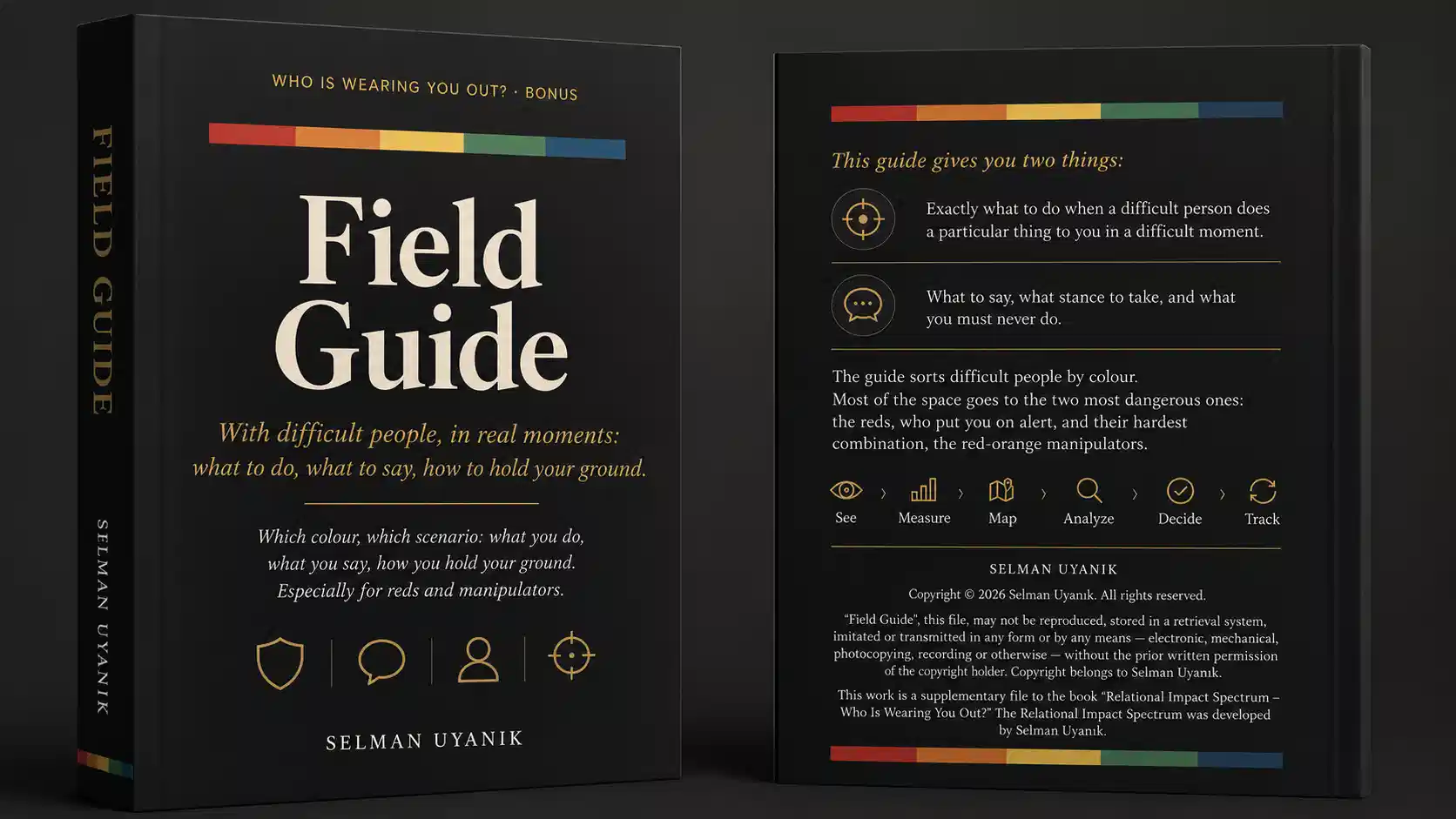
Field Guide
Difficult people, real situations: what to do, what to say, and how to stand your ground.
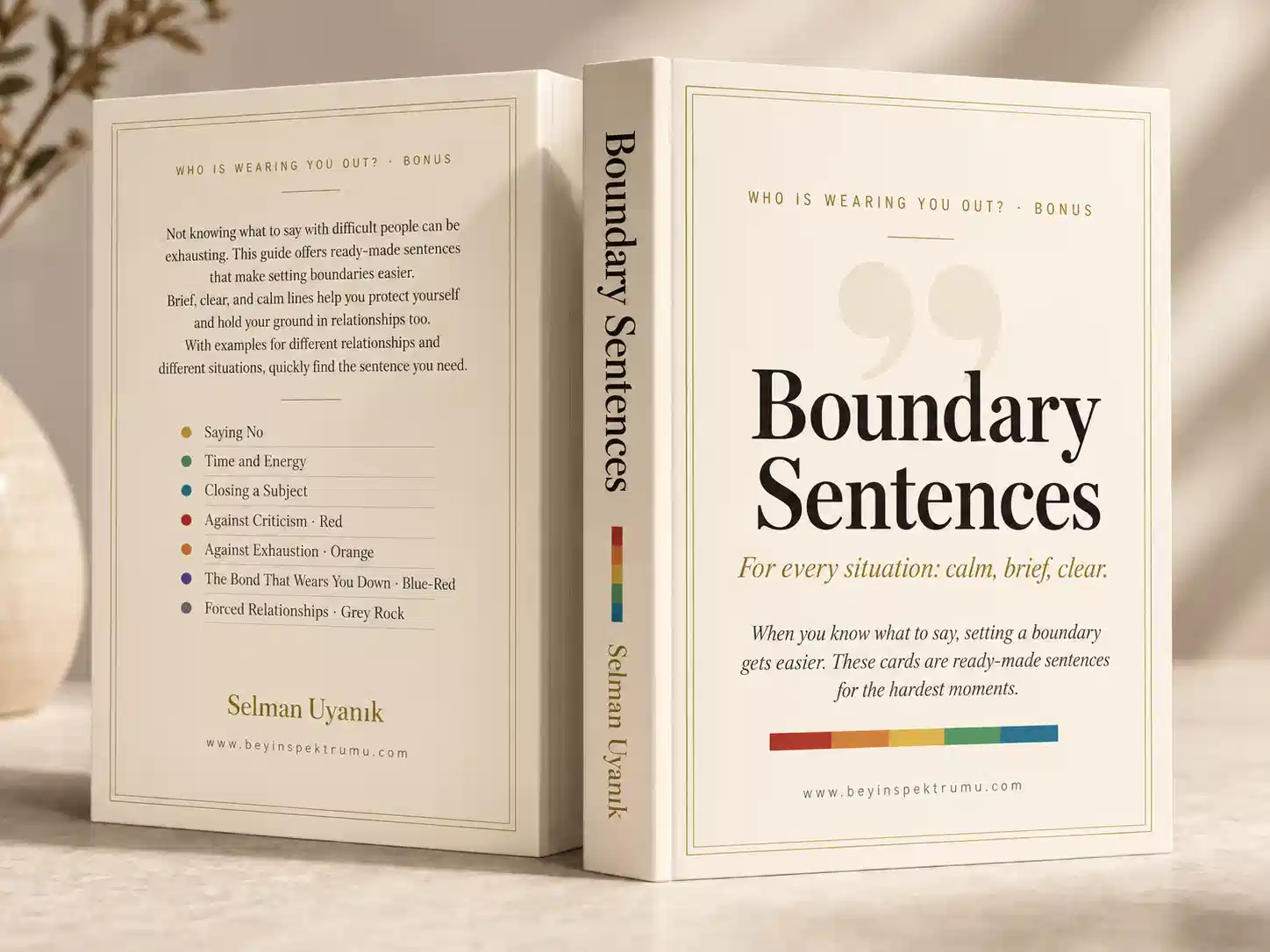
Boundary-Setting Phrases
Ready-to-use phrases for Red and Orange relationships.
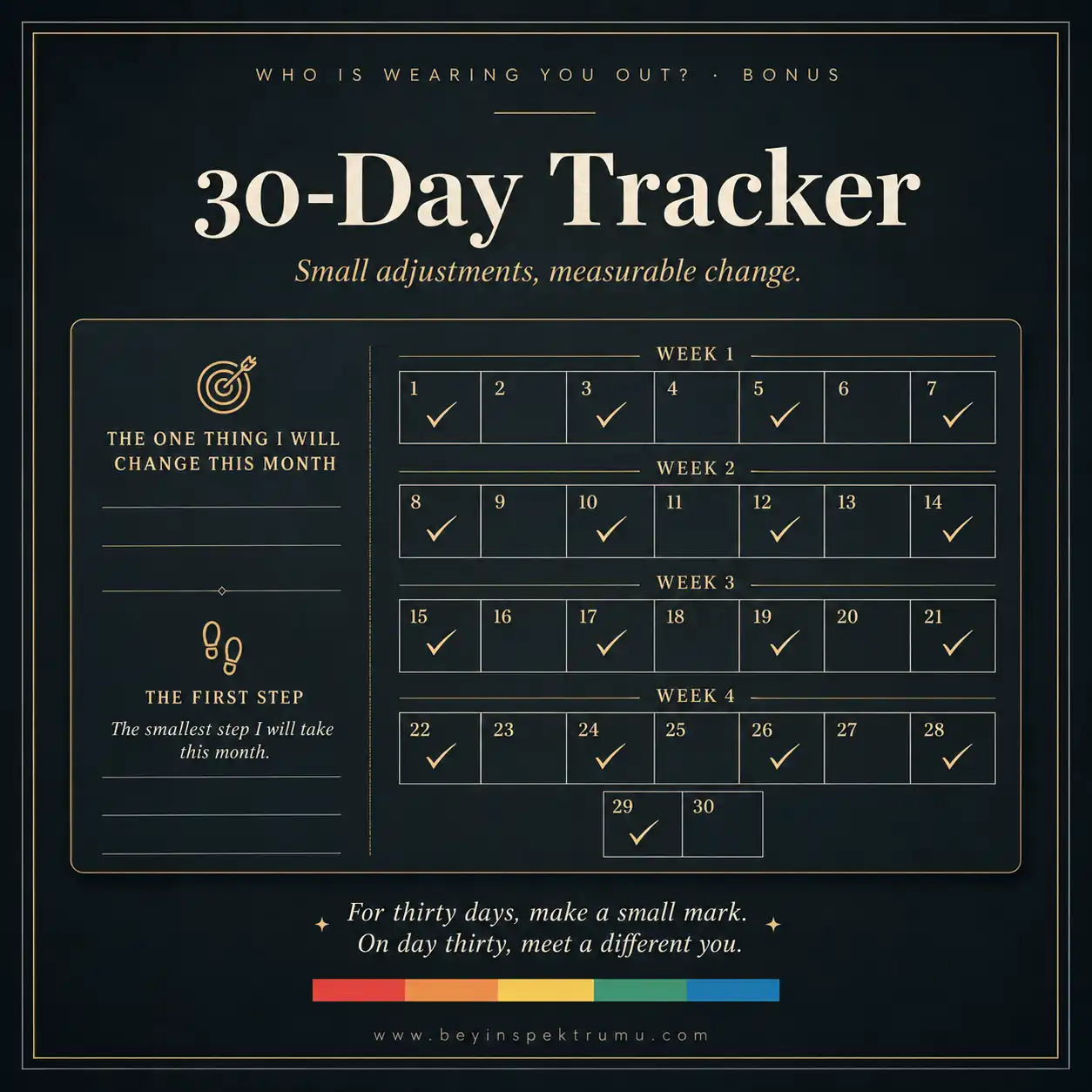
30-Day Tracking Protocol
A daily chart to track how each interaction leaves you feeling.
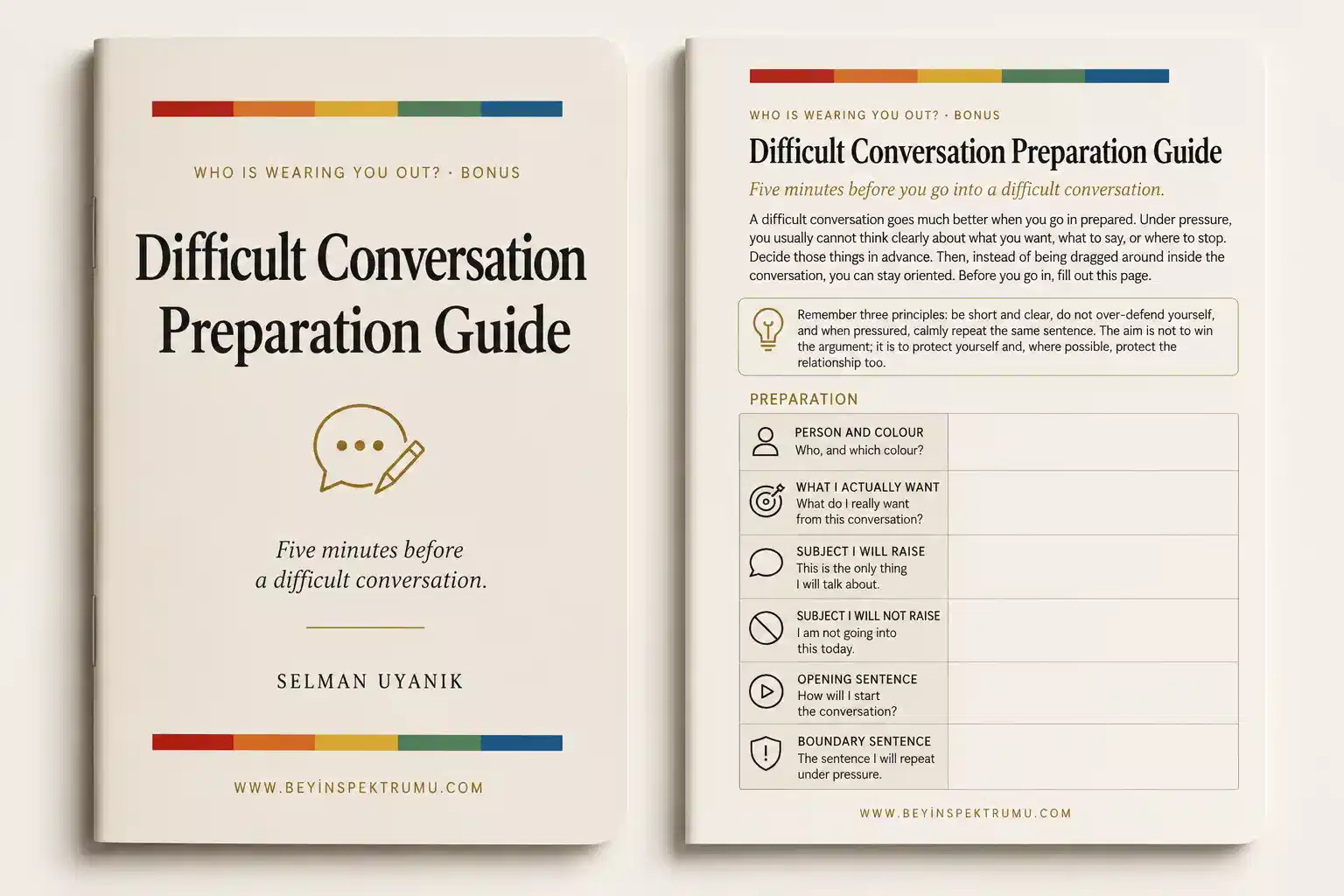
Difficult Conversation Preparation Guide
Before a difficult conversation, take five minutes to get clear on what you’ll say and where you’ll draw the line.
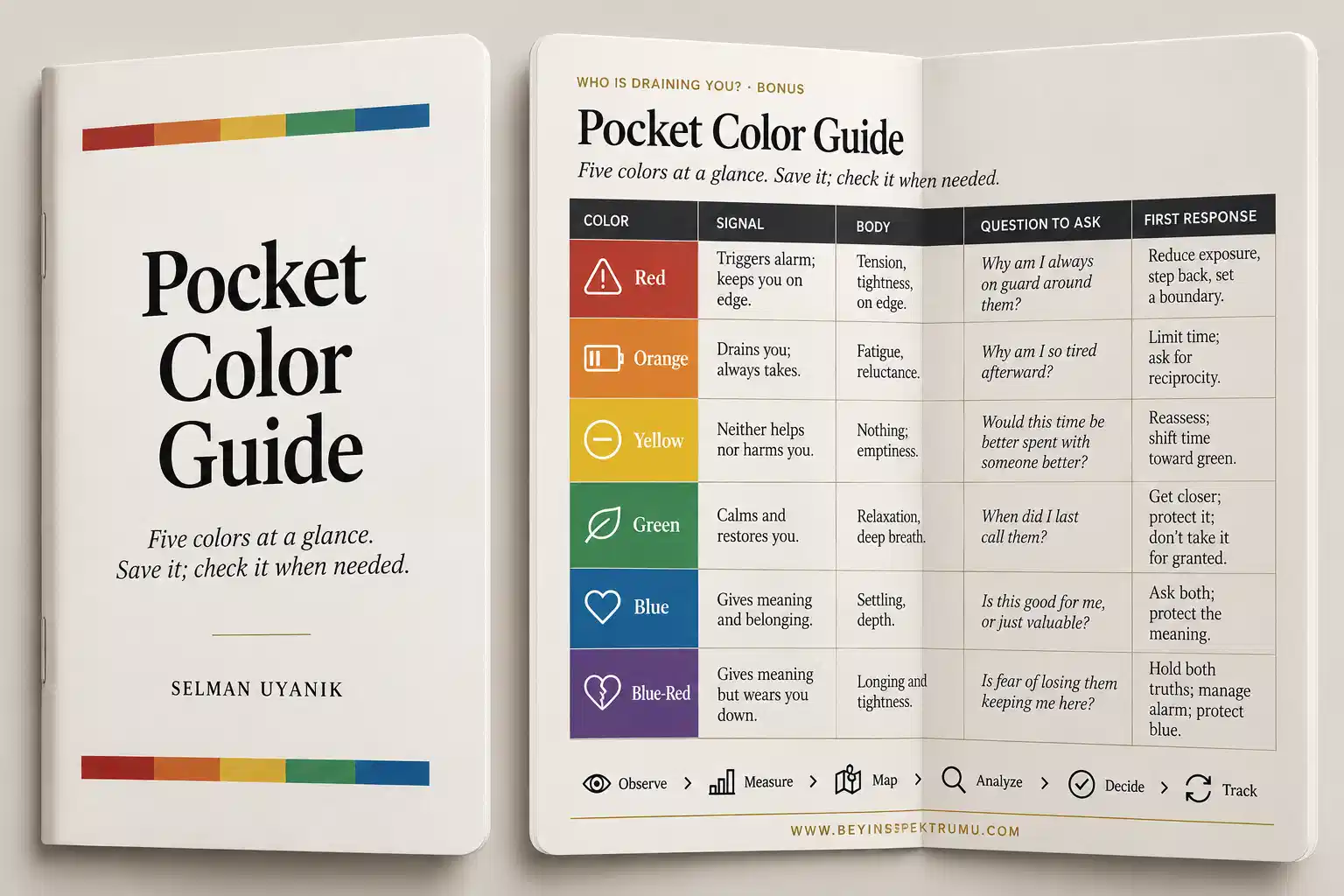
Pocket Color Guide
Five colors at a glance. Save it to your phone and check it when things get difficult.
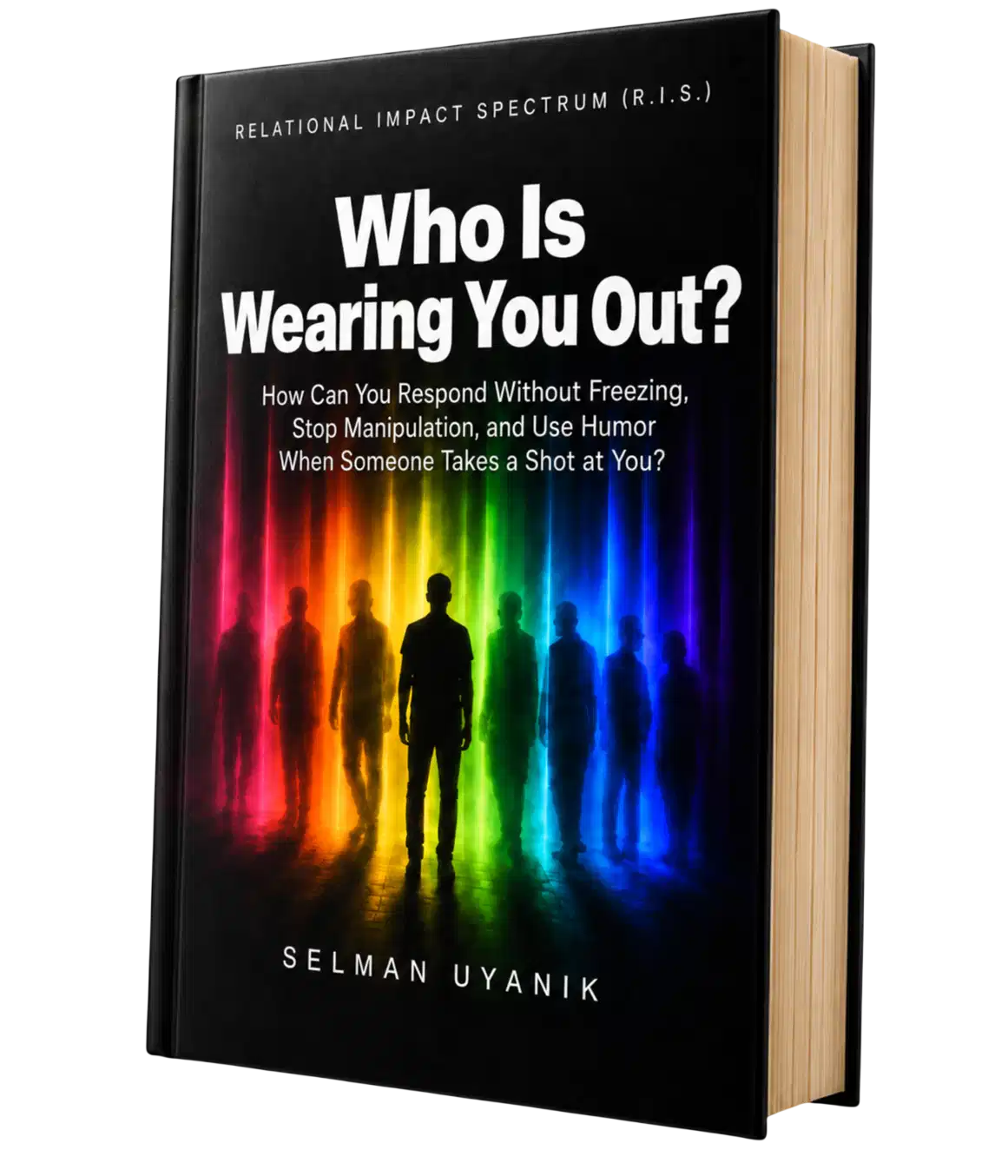
The five bonuses are not sold on Amazon. Leave your details here, order the book, and we will email all five to you within 24 hours.
Your Bonuses, Within 24 Hours
Leave your details before you head to Amazon. Once you have ordered, all five resources arrive by email within 24 hours.
If they don’t arrive, send one email to destek@beyinspektrumu.com and we will sort it out the same day.
Remember this: the person who hurts you most is often the one you can’t seem to walk away from. Beneath what you call “passion,” there is a very different mechanism at work.
The day you give that bond its real name is the day you take back the power it holds over you. This book gives you that name.
The five bonuses only come through this page. Leave your details, order on Amazon, and they are with you within 24 hours.